
The Tools
Four pillars for AI-assisted literature review. Each one shines in a different stage of the workflow. Learn the prompt patterns that turn them from chatbots into research partners.
Google Scholar Labs
Google Scholar's AI-powered search experiment. Instead of keyword strings, you ask a full research question — Scholar Labs identifies key topics and relationships, searches the Scholar index, and returns papers with a short explanation of how each one answers you. Follow-up questions narrow the results.
scholar.google.com/scholar/labs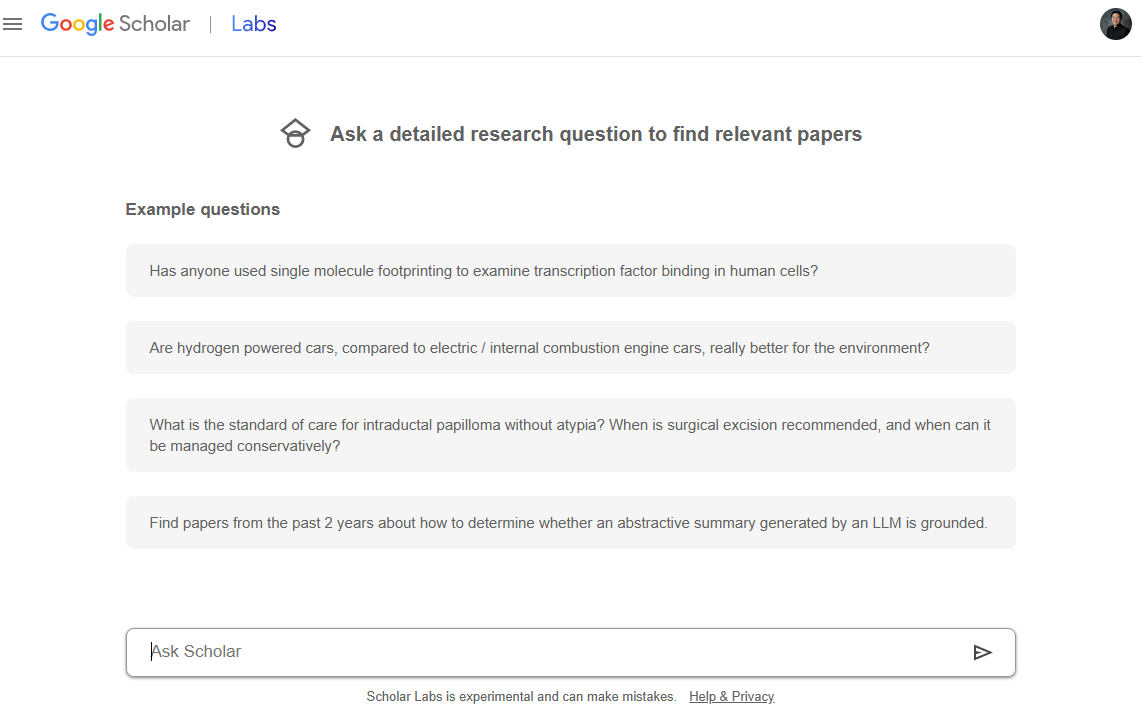
Scholar Labs landing page. Notice the prompt: "Ask a detailed research question to find relevant papers."
Ask like this
"How does generative AI affect students' writing performance and academic integrity in higher education?"
Full question · names the phenomenon, outcome, and context.
Not like this
"AI writing students"
Three loose keywords · no relationship, no scope, no question.
Getting started
Go to Google Scholar and sign in with your Google account.
Look for "Try Scholar Labs" or visit the Scholar Labs page. English questions only; access is gradually rolling out to signed-in users.
Type a complete English research question — phenomenon, context, population, outcome.
For every suggested paper, check
Scholar Labs ranks for relevance, not credibility. Use this checklist before adding a paper to your review.
A workflow that works
Treat Scholar Labs as your exploration layer. Start broad, then narrow with follow-up questions, then switch to regular Google Scholar's Cited by and Related articles for depth.
"What are the main factors influencing teachers' acceptance of generative AI in higher education?"
"Which studies use TAM, UTAUT, or TPACK to explain teachers' AI acceptance?"
"Show empirical studies published from 2020 to 2026 on AI acceptance among university lecturers."
Reminder. Scholar Labs is experimental and still improving. It helps you discover themes, key papers and possible gaps — but the literature review is still yours. Read critically, verify each suggested paper exists, and never cite from the AI summary alone.
Question templates
Scoping question
What does the empirical literature from the past 5 years say about [PHENOMENON] in [CONTEXT/POPULATION]? Prioritise peer-reviewed studies and highlight any systematic reviews or meta-analyses.
Method-focused question
Find papers that use [METHOD, e.g. mixed methods / discourse analysis / fNIRS] to study [TOPIC] in [SETTING]. Include both seminal and recent (post-2022) work.
Contradiction hunt
Are there papers that challenge or contradict the common claim that [CLAIM]? I want to see studies that report null results, opposing findings, or critical commentary.
Gap-spotting question
What gaps or under-researched areas have authors themselves identified in the literature on [TOPIC]? Prefer papers whose discussion or limitations section explicitly names future research directions.