
Part 2
The Tools
Four pillars for AI-assisted literature review. Each one shines in a different stage of the workflow. Learn the prompt patterns that turn them from chatbots into research partners.
Conversational discovery
Scholar Labs
Source-grounded synthesis
NotebookLM
Deep Research & long context
Gemini
Custom GPTs & Projects
ChatGPT
Skills & long-form writing
Claude
Gemini
Google's flagship model with two killer features for researchers: Deep Research for autonomous multi-step web searches, and a 1M+ token context window for dropping in entire papers (or several at once).
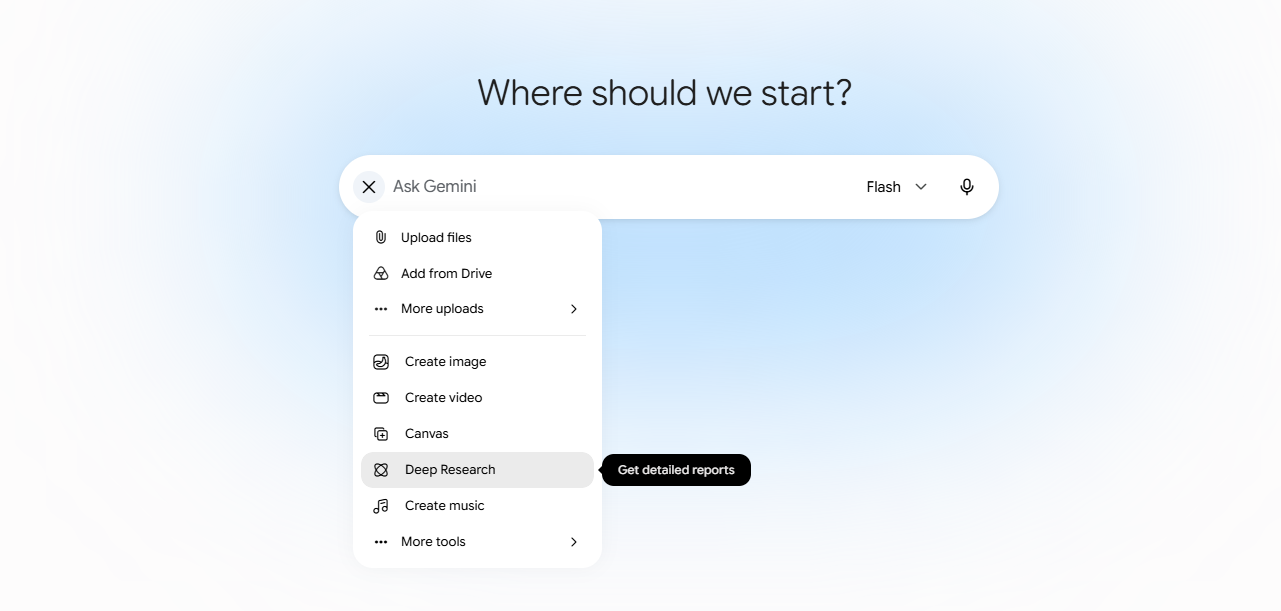
Deep Research mode
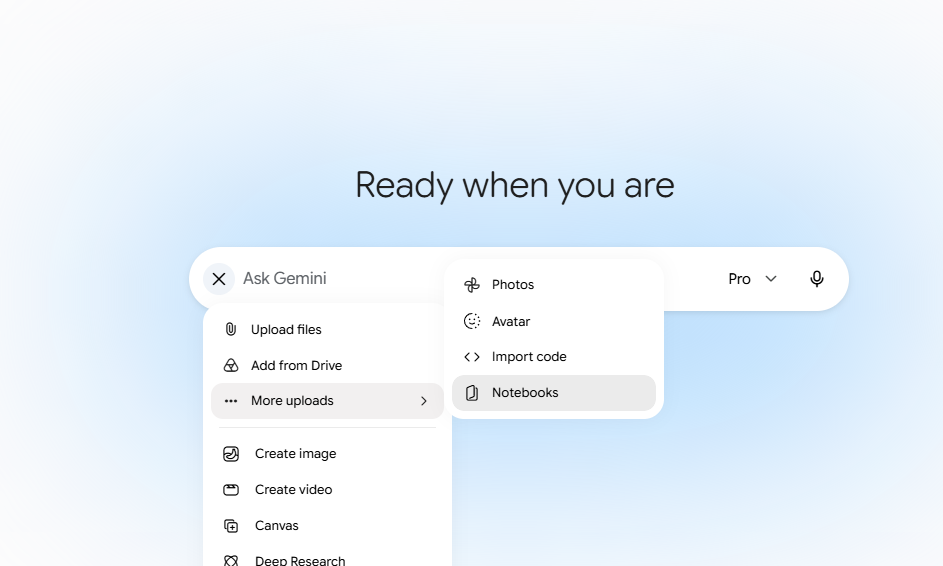
Gemini + Notebooks (Amazing combo)
When to reach for it
- ✦ Early-stage scoping: you need a Deep Research report on a topic in 5–10 minutes.
- ✦ Long-context tasks: comparing 5–10 full-text papers in a single conversation.
- ✦ Multimodal inputs: figures, tables and equations from PDFs.
Prompt cards
Deep Research
Deep Research scoping prompt
Act as a systematic literature reviewer. Conduct deep research on:
Topic: [INSERT TOPIC]
Scope: peer-reviewed articles, 2019–2025, English.
Deliver:
1. A taxonomy of the field (key sub-themes).
2. Top 15 most-cited works with one-line takeaways.
3. 3 emerging research fronts.
4. Outstanding debates and contradictions.
Provide a bibliography with DOIs at the end.
Long context
Cross-paper comparison
I am pasting [N] full papers below. For each, extract:
- Research question
- Theoretical framework
- Method & sample
- Key findings
- Limitations
Then produce a comparative matrix and a 200-word synthesis identifying convergences and disagreements.
Planning
Refine a Deep Research plan
Here is the Deep Research plan you proposed. Revise it:
- Replace generic web sources with academic databases.
- Add inclusion / exclusion criteria (PRISMA-style).
- Specify the output as a structured table, not prose.
- Limit to studies published in [DATE RANGE].
Critique
Methodology critique
Based on the full text I provided, critique the methodology of [AUTHOR, YEAR]:
- Sampling and ecological validity
- Operationalisation of key constructs
- Statistical choices
- Threats to internal and external validity
End with: "If I were replicating this study, I would change …"
Theory
Theoretical lineage tracer
Using Deep Research, trace the theoretical lineage of [THEORY / CONSTRUCT].
Deliver:
1. The originating work (author, year, DOI).
2. Key extensions and revisions in chronological order.
3. Major critiques and counter-theories.
4. Current status in [MY DISCIPLINE] as of 2024–2025.
Provide DOIs for every cited work.
Synthesis
Conflicting findings reconciler
Across the papers I pasted, locate findings that disagree on [SPECIFIC QUESTION].
For each disagreement:
- Quote the conflicting claims (with author + year).
- Compare samples, measures and analytic methods.
- Suggest the most plausible explanation for the conflict (moderator, measurement, context).
Conclude with one testable hypothesis my study could address.
Verify sources
Source & DOI verification pass
Audit your previous response for hallucinated or unverifiable references.
For every citation you produced:
1. Confirm the author(s), year, title and journal exactly.
2. Provide a working DOI or stable URL.
3. If you cannot verify it with a real source, mark it [HALLUCINATED] and remove.
4. Flag any quotation that is paraphrased rather than directly traceable to the source.
Return a clean, verified reference list plus a separate "Removed / unverifiable" list.