
The Ethics
AI use in research writing isn't forbidden — it's regulated. Every major publisher now expects transparent disclosure. Get this right and you protect your integrity, your reviewers' trust and your career.
Integrity
Disclosure preserves the chain of authorship — readers know what is yours and what was machine-assisted.
Compliance
Undisclosed AI use is grounds for desk rejection — and increasingly for retraction at major journals.
Reproducibility
Naming the tool, version and purpose lets others evaluate (and replicate) your method.
Publisher policies
The four largest scholarly publishers all converged on similar rules in 2023–2024. Read the source policy before submitting.
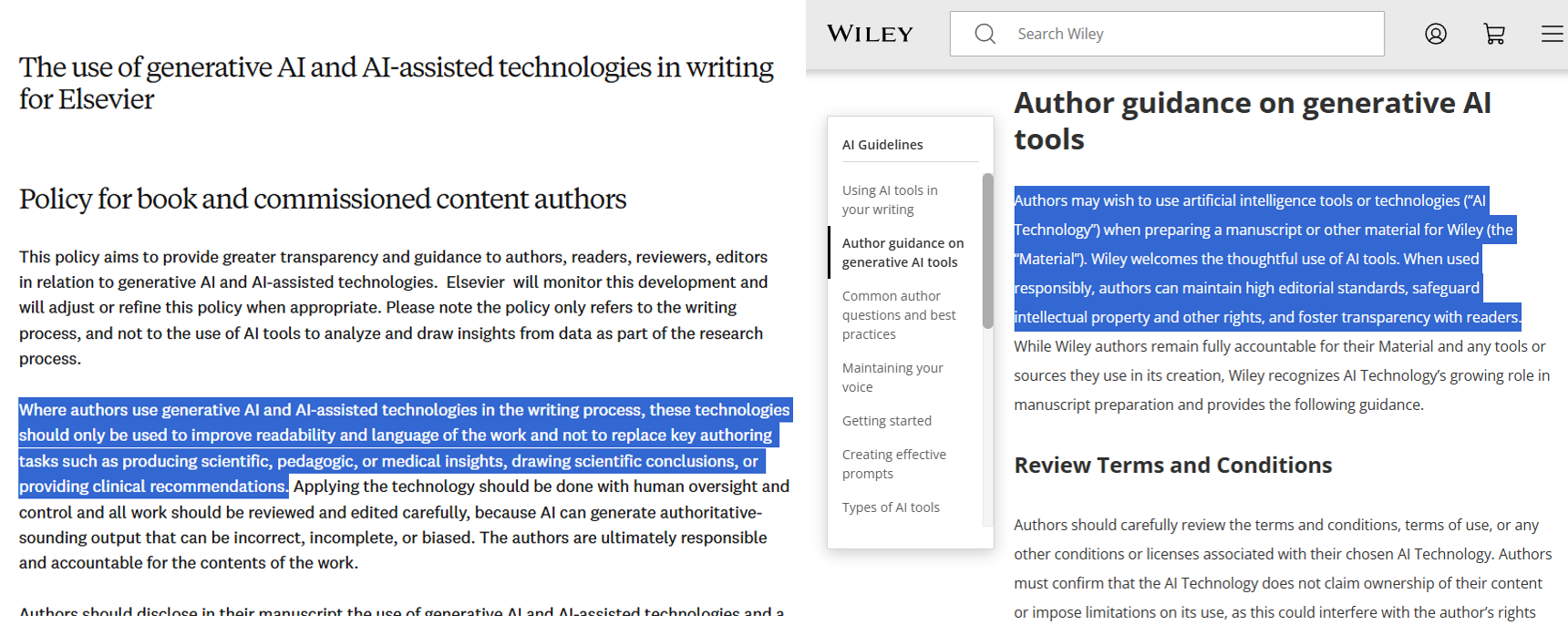
Elsevier & Wiley
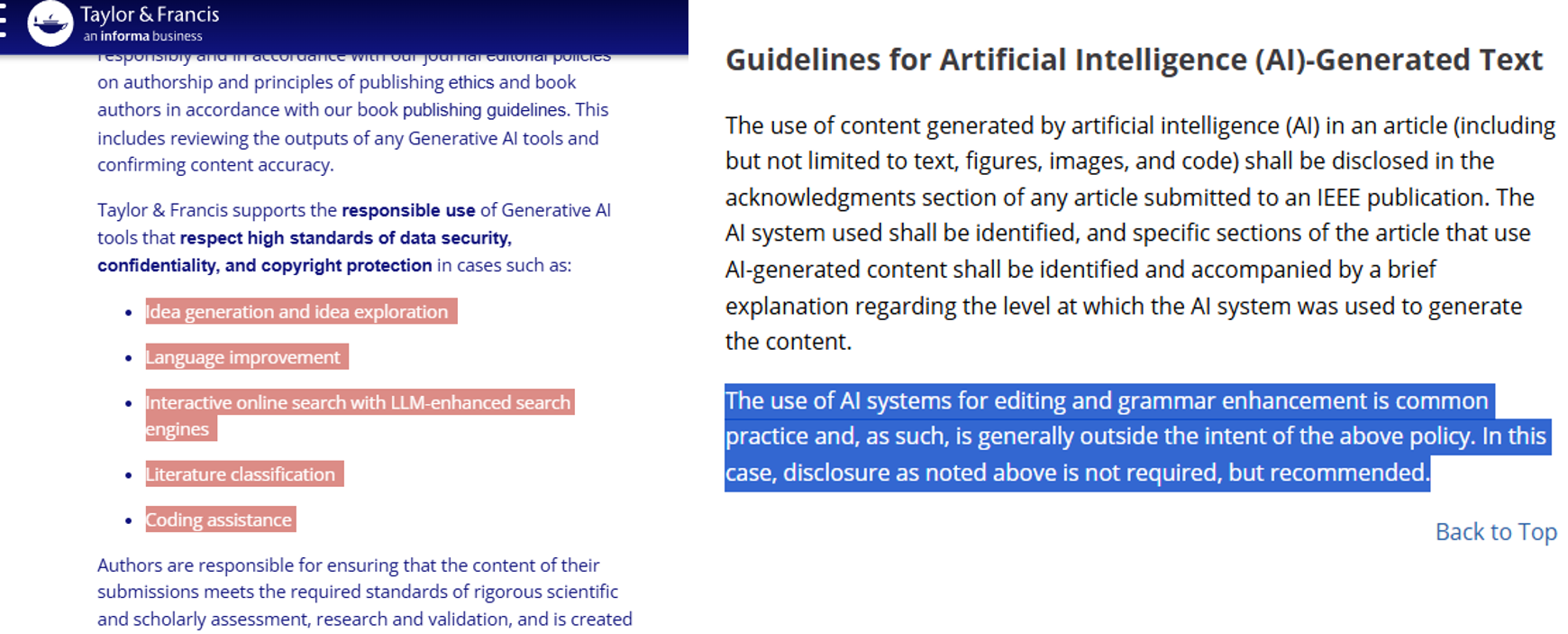
Taylor & Francis & IEEE
Elsevier
Read policy ↗- AI may be used to improve readability and language, not to generate content.
- AI cannot be listed as an author.
- Authors must disclose AI use in a dedicated statement before the references.
Wiley
Read policy ↗- AI must not be cited as an author; humans take full responsibility.
- Use of generative AI in writing must be disclosed in Acknowledgements or Methods.
- AI-generated images are generally not permitted.
Taylor & Francis
Read policy ↗- Generative AI cannot be credited as an author.
- Any use of AI tools in the research or writing process must be transparently declared.
- Authors remain accountable for accuracy, originality and integrity.
IEEE
Read policy ↗- AI-generated text or code must be flagged and the prompts retained.
- Use of AI-content generators must be disclosed in the Acknowledgement.
- AI cannot be listed as an author or co-author.
Sample disclosure statements
Adapt one of these for the Acknowledgements or AI Use Statement section of your manuscript. Always name the tool, version (if known), and purpose.
Minimal disclosure
During the preparation of this work, the author(s) used [TOOL NAME, VERSION] to improve language and readability. After using this tool, the author(s) reviewed and edited the content as needed and take full responsibility for the content of the publication.
Standard disclosure
The author(s) acknowledge the use of [TOOL NAME, VERSION] in [PURPOSE — e.g. summarising prior literature, refining the abstract, generating initial drafts of paragraphs that were subsequently rewritten and verified]. The author(s) reviewed, verified and edited all AI-assisted content and take full responsibility for the integrity, accuracy and originality of this publication.
Detailed disclosure
AI Use Statement
Tools used:
- NotebookLM (Google) — to query and summarise an uploaded corpus of [N] papers.
- ChatGPT (OpenAI, GPT-X) — to refine paragraph structure in the literature review.
- Claude (Anthropic) — to check coherence of the discussion section.

AI was NOT used to: generate citations, fabricate data, write the methodology, or produce the conclusions. All AI-assisted text was reviewed, verified against original sources and edited by the human authors, who take full responsibility for the final manuscript.