
Part 2
The Tools
Four pillars for AI-assisted literature review. Each one shines in a different stage of the workflow. Learn the prompt patterns that turn them from chatbots into research partners.
Conversational discovery
Scholar Labs
Source-grounded synthesis
NotebookLM
Deep Research & long context
Gemini
Custom GPTs & Projects
ChatGPT
Skills & long-form writing
Claude
NotebookLM
Your private, source-grounded research notebook. Upload up to 300 PDFs and ask questions that are answered only from those sources — with inline citations.
When to reach for it
- ✦ You have a corpus of 20–300 papers and need cross-source synthesis.
- ✦ You want answers with verifiable citations back to the source PDFs.
- ✦ You want auto-generated briefings, study guides, mind maps, or an audio overview to listen to during a commute.
Configure Chat — give NotebookLM a voice
Inside any notebook, open the Chat panel, click the settings icon, choose Custom, and paste a brief that tells NotebookLM how to think, write and cite. Every answer in that notebook then follows the brief.
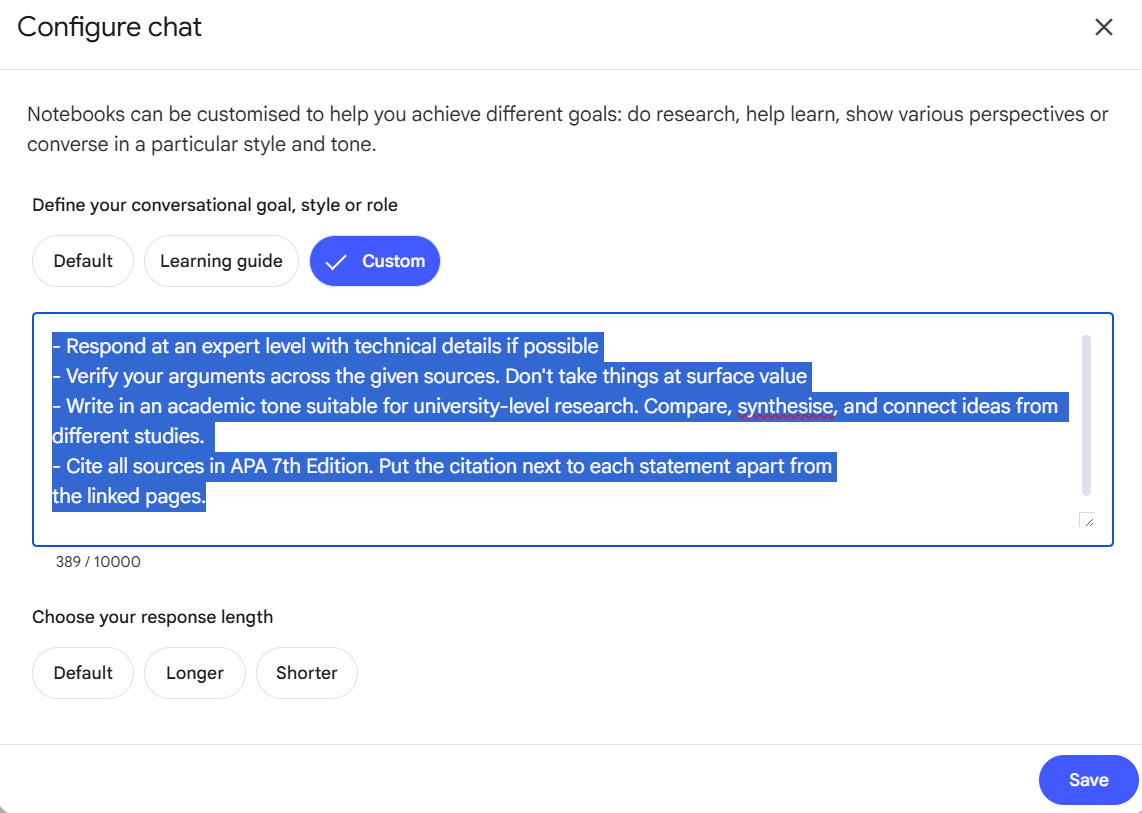
Example brief for an academic notebook
Configure chat
Academic chat configuration
- Respond at an expert level with technical details if possible.
- Verify your arguments across the given sources. Don't take things at surface value.
- Write in an academic tone suitable for university-level research. Compare, synthesise, and connect ideas from different studies.
- Cite all sources in APA 7th Edition. Put the citation next to each statement apart from the linked pages.
Tip: pair this with a response length of Longer when drafting literature review paragraphs, and Shorter when scanning for quick facts.
Prompt cards
Synthesis
Thematic synthesis across sources
Acting as a literature review assistant, analyse all sources in this notebook.
1. Identify 4–6 major themes that recur across at least three sources.
2. For each theme, list which sources support it and which (if any) contradict it.
3. Highlight one underexplored angle that would justify further research.
Cite source titles inline.
Gaps
Gap analysis
Based ONLY on the uploaded sources, identify:
- Methodological gaps (under-used methods, narrow samples).
- Conceptual gaps (constructs defined inconsistently or assumed).
- Contextual gaps (settings, populations, time periods not covered).
For each gap, name the closest source and why it falls short.
Mapping
Author position map
Create a table that maps each source's:
| Author (Year) | Theoretical stance | Method | Key finding | Limitations stated |
Use only what is explicitly stated in the sources.
Quotes
Quotable evidence finder
Find 5 short, directly quotable statements from the sources that support the claim:
"[INSERT YOUR CLAIM HERE]"
For each quote provide: exact wording, source title, page if available, and why it's relevant.
Theory
Theoretical framework comparison
Across the uploaded sources, identify every theoretical framework or model used.
For each framework:
- Name it and cite the originating source in this notebook.
- List which papers apply it and how (extension, critique, replication).
- Note any framework that appears only once — could it be a niche opportunity for my study?
Summarise in a table.
Timeline
Chronological evolution of the field
Using only the sources in this notebook, build a chronological timeline of how the conversation on [TOPIC] has evolved.
For each period (e.g. pre-2015, 2015–2020, 2021–present):
- Dominant questions being asked.
- Methods in vogue.
- Turning-point papers (cite source titles).
End with one sentence on where the field appears to be heading next.
Verify sources
Citation & claim verification
Go back through your last answer. For EVERY claim you made:
1. Quote the exact passage in the source that supports it.
2. Name the source and page/section.
3. If you cannot find a supporting passage, mark the claim [UNSUPPORTED] and remove it.
Do not paraphrase loosely — I need a direct trace from claim → source text. If a citation chip points to a passage that doesn't actually say what you claimed, flag it as [MISATTRIBUTED].